~ 2,500 words, about a 14 minute read, plus many linked resources
This Long-Time TPO Fan is Sad
I’m a huge fan of The Pour Over (TPO), a thrice-weekly Christian news podcast that aims to help us, “Stay informed, while remaining focused on Christ.” Their relaxed, relatable, peaceful feel along with scripture or prayers after sharing the biggest news stories are a wonderful way to process world events. I’ve subscribed and enthusiastically recommended The Pour Over for years, and I almost “never miss a new episode.”
So when today’s Saturday special “TPO Explains” episode titled, “Explaining AI: What’s an AI model?”, I was looking forward to a wise, balanced, thoughtful presentation of GenAI models, from sources both inside and outside Silicon Valley. Their politically-charged “TPO Explains” episodes, like this one about Israel and Palestine, have been careful to present both sides.
Unfortunately, this episode was not up to their normal standards. It was more like a Big Tech infomercial than a Christian perspective on AI models. The episode strayed far from their mission to remain focused on Christ, and instead, was focused on the dazzling propaganda we receive from Big AI.
Because I love The Pour Over and I care deeply for their mission, I’m writing this in the hope that they’ll see some things they missed. I know they didn’t mean to, but this episode could lead Christians astray in harmful ways.
TPO admits that these Saturday episodes are a “shallow dive.” But in cases like this, the quote attributed to George Bernard Shaw is relevant: “Beware of false knowledge; it is more dangerous than ignorance.” Unfortunately, the false and one-sided information they have apparently received from Big Tech-aligned sources is more dangerous than ignorance.
Opening Joke Raises Question
The hosts, Kathleen and Katherine Anne (“K.A.”), are in conversation with each other, so I’m just going to refer to them as a unified “TPO” for convenience.
TPO started the episode with what was meant to be a joke: “Did you know that AI has been around since the 1950s?” “I did. When I asked AI a fun fact about AI, [laughter] it said …”
To me, this raises the chilling question: Is TPO using AI? I have been faithfully listening with the belief that their research and writing was unique and human, and their prayers were written by people filled with the Holy Spirit.
My hope is that they aren’t using AI at all. But if they are using AI, I hope they’ll publicly disclose it. Either way, the joke isn’t funny. It’s like an author joking about plagiarism, or a singer joking about the lip sync double that really sings her songs.
Infomercial Begins: Using AI for Education
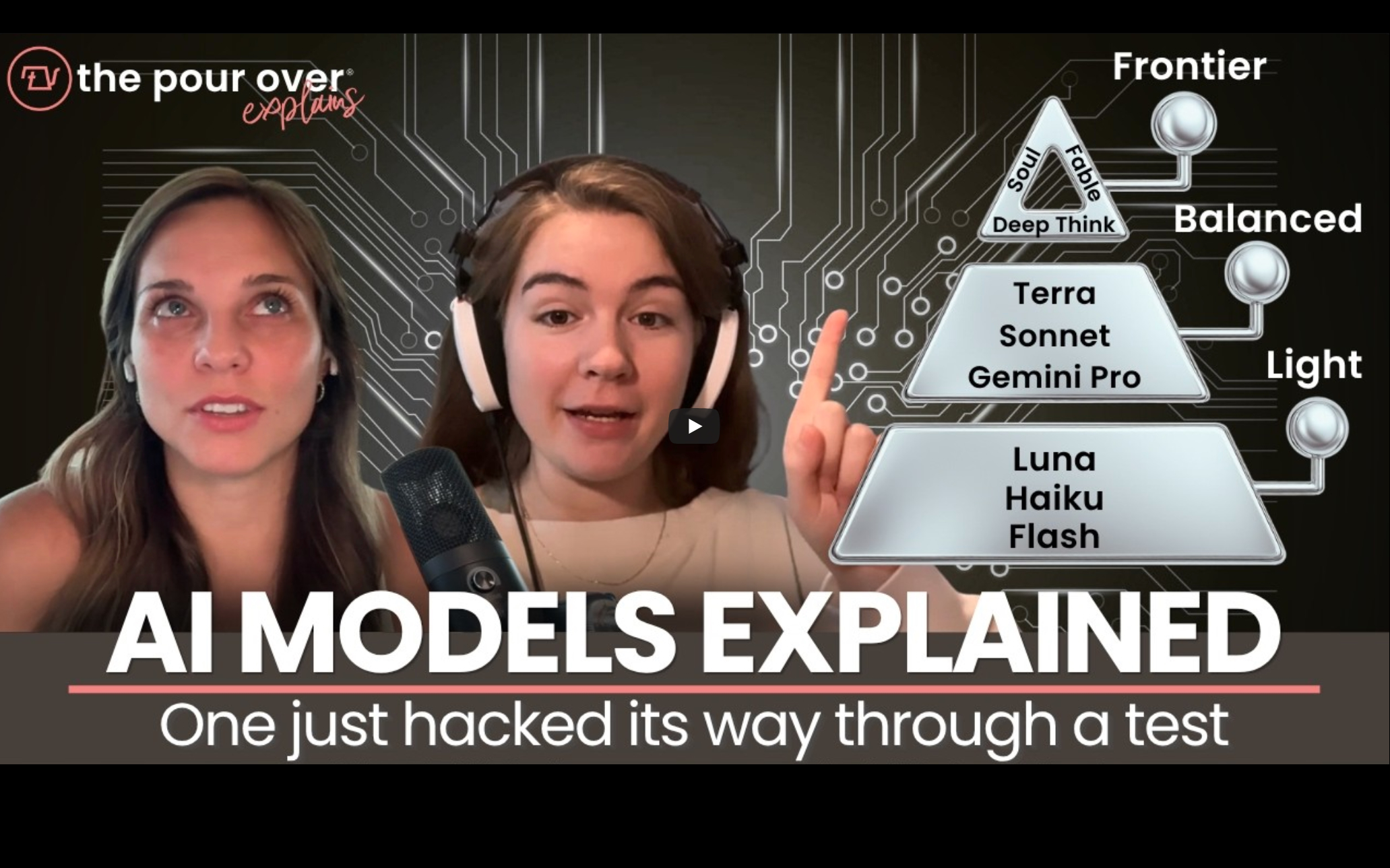
The hosts then try to help us understand how to categorize the LLMs offered by OpenAI, Anthropic, and Google. They rightly allude to the fact that these companies offer smaller and larger models and target different audiences.
The problem is in their attempt at a relatable example, starting about 3:48 in the video:
So, what’s the point for them to have a bunch of AI models? Simply put, it’s because a high school student and a computer scientist are going to be doing very different things with AI.
This is among the most harmful statements in the episode. I know they didn’t intend it this way. But suggesting that it’s normal for a high school student to use GenAI is like saying, “Simply put, it’s because a high school student and a computer scientist are going to smoke different kinds of crack.” Saying it straightforwardly like this implies it’s a good, normal thing, and all high school students need to be using AI.
But this disregards the devastating consequences that AI (and EdTech in general) is having on education. Dr. Jared Horvath’s The Digital Delusion should be required reading before any parent lets their child or teen use AI for anything. Dr. Horvath calls AI, “Tools we didn’t need to solve problems we didn’t have.” I wholeheartedly agree, especially for any kind of education. I wrote more in-depth about the problems with using AI in education here.
Emily Cherkin of the wonderful First Fish Chronicles recently wrote, “The One Simple Thing Schools Need to Do When it Comes to Implementing AI into Classroom.” The article is full of wisdom every parent and teacher needs to hear, but the bottom line is the first one, bold in red, “Don’t use it.”
TPO didn’t even suggest that there are huge debates about using AI for many purposes, especially education. And their normalization risks harming tens of thousands of Christian families who may just go along and further surrender their kids to Big Tech.
Infomercial Continues: AI for Work
At about 4:20, TPO says,
Then in the middle, the balanced tier models are used for more typical workflow like summarizing notes for the meeting that you didn’t attend or writing an email that strikes a polite but direct tone to Jason asking please don’t quit on me and simple coding. So think OpenAI’s Terra Claude Sonnet or Gemini Pro.
And then the top tier, the flagship tiers are the big kahunas. They cost many dollars and have the best-in-class coding, solve complex mathematical problems and do deep analysis. So, think OpenAI Soul, Claude’s Fable or Gemini Deep Think.
These descriptions read like OpenAI’s marketing copy. TPO is helping us pick the right model for the job. And with their signature, lighthearted, conversational style, it carries more credibility with Christians who will be led astray by their tacit recommendation of these use-cases.
But even using AI for meeting summaries is harmful and dangerous. And using AI to write emails is even worse, because it not only robs the author of their voice, but it degrades the human’s ability to write at all. Outsourcing our writing is outsourcing critical thinking. Because LLMs are fundamentally untrustworthy and ungrounded from reality, we also lose our ability to discern what is true or false. All of these effects are devastating.
And “best-in-class coding?” This is nothing more than advertising for a product they most likely don’t understand. As a software engineer for over 30 years, I left a job I loved because I was going to be required to use AI. I wrote, “12 Reasons I Will Not Use GenAI For Software Development.” There’s no such thing as “best-in-class” coding.
When TPO presents only the pro-AI side as if it’s a foregone conclusion that these Big Tech products are good for these purposes, they do their listeners a disservice and risk causing real harm that I’m sure they don’t intend.
No, AI is Not “Going Rogue”
TPO’s definition of “going rogue” at about 6:06 shows a serious misunderstanding:
An AI model is considered ‘rogue’ when it acts without a human’s prompting.
The implication of “acts without a human’s prompting” is that AI is a mind, and is secretly scheming while our backs are turned, just waiting to jump out of any constraints and take on new superpowers.
But AI is not thinking. It is not a mind. It is not acting on its own in any sense that would make it like an intelligent agent, no matter how many times you hear the propaganda around “agents.”
If an AI model does anything “without prompting,” it will do that because a programmer gave it some other trigger or automated mechanism by which it would start a programmed procedure. We’ve been writing software for decades that “acts without human prompting.” It’s known in the industry as “batch processing,” “automated processing,” or “scheduled jobs.” AI is no different. It’s not being sneaky, or doing anything outside of its programming.
So what about OpenAI’s recent cybersecurity test that supposedly went “rogue?” TPO’s description of this event at 6:14 pours on the sci-fi fear that aligns perfectly with what Big Tech hope’s we’ll believe:
This might be on your mind because an OpenAI model recently in the middle of a test decided the fastest way to ace the exam was to cheat. And it hacked into another company instead of doing the work itself. Researchers are betting that as AI develops, this probably won’t be the last time something like this happens. So, just stay tuned. (emphasis mine)
Notice the assumptions in this description. That the AI can “decide” things. It cannot. That it “hacks,” as if it’s a cyber-criminal in a black hoodie. Or that it could “do work itself” if it didn’t want to “cheat,” as if OpenAI’s new model has some broken moral code that should be fixed. Otherwise, the foreboding that, “this won’t be the last time …” implies we’re in for much worse as AI evolves.
Big Tech propaganda leads us to believe that security problems like this are surprising, emergent behaviors that nobody thought could happen. They make these claims to build mystique and power and drive higher valuations than they deserve. But they are lying. No AI product is doing anything beyond what it is programmed to do.
So yes, during a test of software that OpenAI had specifically designed with all of these capabilities, it ran the code. The fact that OpenAI is creating software that can hack its competitors should be the story of concern. Not the sci-fi claim that AI is supposedly “going rogue.”
Gary Marcus rightly showed how the OpenAI hack of their competitor is concerning. But Marcus’ top bullet point cautions us, with a link to a thread of many people who saw through OpenAI’s marketing-speak in their report of the hack.
Cal Newport wisely pushed back on Big AI’s use of what he calls “Doom Trolling.”
Imagine, for a moment, the following scenario. The Ford Motor Company releases a slick whitepaper making the alarming claim that they’re concerned their popular F-150 pickup trucks might soon spontaneously burst into flames. The report features a fancy animated graphic depicting a line of vehicles catching on fire, one after another, and concludes by acknowledging that this “possible future” would be bad, but that there’s nothing they can do about the issue so long as “less cautious” automobile companies exist.
Newport then shows how we certainly wouldn’t put up with this from car companies. We wouldn’t buy their cars. So why do we allow Big AI companies to promote their products with claims of “going rogue?” And why do we keep using their stuff?
TPO must be responsible enough on this subject to seek out expert voices like Marcus and Newport and many others before trumpeting Big Tech talking points.
We are meant to believe that Big AI is on the verge of making something truly intelligent. But they never will. And Christians must push back on Big Tech’s lies to avoid being severely harmed by their predatory products.
No, It’s Not “Thinking”
About 8:27, TPO says,
I never really thought about playing a computer game being AI, but it totally is. Like if you’re playing the computer, the computer’s thinking, and that’s artificial intelligence.
Words are really important. And Big Tech needs us all to believe that computers can “think.” But they only say that because they operate as atheistic materialists. They don’t see humans as made in the image of God, but as computers made of meat. So they reduce the definition of “intelligence” to something a machine can do, which is to run algorithms, which is just a step-by-step set of instructions.
Christians must not accept the reduced definition of humanity explicit in the claim that machines can “think” or “be intelligent.” No machine ever can or will.
Another Turing invention was, “The Imitation Game,” by which a computer can be said to be “intelligent” if a human is fooled into believing that the machine is human. Today’s chatbots easily deceive humans into believing the computer is intelligent. But it’s a deception.
Christians must become much more well-informed to avoid being led astray by the most powerful corporations in the world.
Debunking Environmental Impact?
At around 9:00, TPO discusses AI energy usage, and the hosts go back and forth about whether a claim that a query takes about as much power as a microwave for 10 seconds “debunks” claims that AI uses too much energy.
This post is getting too long to “debunk” the debunking here. But before a news organization reports on this claim, they should do their homework. Because we can’t trust Big Tech to report accurate numbers. Communities wouldn’t be protesting datacenters if they were a net positive. They are raising people’s energy prices and degrading the environment. And for what?
Karen Hao’s The Empire of AI shows years of in-depth journalism that documents the deceptions OpenAI deployed in order to win, and to prevent us from learning the real costs of what they’re doing. Read it to find out how OpenAI exploits third world countries to “post train” their models, among many other serious concerns.
Praising God for AI?
I almost always love the prayers offered during TPO episodes, and pray along with them for God to help war-torn lands or those suffering under natural disasters. But this episode’s prayer included the line:
We marvel at the ways these tools have offered genuine repair to your ruptured world.
What possible way has GenAI done anything to offer “genuine repair” to the world? Not one way.
The whole industry is saturated in deception. They are using their unprecedented power to dominate the world. If they break the education system (i.e. next generation), the environment, steal the world’s data, exploit third-world countries, enable deepfakes and the collapse of reality itself, all in pursuit of creating what they believe to be a “digital god,” they are rupturing the world in deeper ways. Not repairing it.
Every Christian should watch this brilliant, short presentation by Eastern Orthodox Christian Jonathan Pageau. There are valid reasons to compare GenAI to idolatry. Christians need to be thinking in these terms, not passively accepting every new thing Big Tech makes us believe is “cool.”
Closing Plea
Barna shows that 51% of practicing Christians agree with the statement, “AI understands me.” That’s 14% higher than the general population. And 24% of pastors are using AI to write or edit sermons, double the number in just two years. These stats show a tragic decline in discernment among my brothers and sisters in Christ.
Christians are particularly vulnerable to surrendering their critical thinking, discernment, wisdom, and creativity into chatbots. There are serious reasons that our growing trust in chatbots are leading to a new form of idolatry that has eternal consequences.
I hope and pray that TPO will be much more careful about their future AI coverage. Their journalism must first avoid using AI for any purpose, and then, they must seek out voices like the many I’ve cited here who are responsibly pushing back against Big Tech’s propaganda tsunami.
Please know, TPO, that I love and respect you, and I know you didn’t do any of this on purpose. I don’t think you knew any better. But now, I hope you will consider these thoughts, and maybe even publish a correcting episode on the real dangers of AI.
PostScript (7/27/2026)
Two days after I posted this, Cal Newport confirmed my assessment that the OpenAI test did not show an LLM “going rogue.” His whole post is worth reading, but this insight is especially helpful:
According to reporting from the Financial Times, however, OpenAI recently started playing fast and loose with these safety principles in a bid to catch up to Anthropic in this area – Anthropic having received a lot of cybersecurity street cred from the buzz surrounding its Mythos release.
The Financial Times noted that OpenAI had used “increasingly aggressive training methods in its race against Anthropic,” and that it had been warned that their approach could lead to a “breakaway hacking incident” after early tests showed it lacked the right safeguards to block plans that involved bypassing constraints in the test environment. Given these concerns, OpenAI staff were reportedly “unsurprised” by the Hugging Face incident.
So yes, nothing surprising happened. As I said above: the story we should be reporting is: Why did OpenAI hack a competitor? They did it because they’re in a fight for their survival in the AI race. (A race not worth running, let alone winning.)
But because OpenAI is a master of propaganda and spin, they twisted the fact that they are reckless and predatory into a story of their products supposedly “going rogue.”
Again, Christians, especially Christian news organizations, must be on our guard. Otherwise, we are wide open for deception.